
SASSA Appeal for R350 Declined 2026
Getting a SASSA appeal for R350 declined notification is stressful, especially when you depend on that money to cover basic needs. Before panicking, it helps to understand that a declined SASSA SRD grant does not mean your application is permanently rejected it simply means something in your profile triggered an automatic flag in the system.
The most common reasons SASSA declines applications include alternative income detected, identity verification failed, NSFAS registration found, or a source of income identified against your ID number. Each of these has a specific fix.
If your SASSA status check shows declined, you have the legal right to submit a SASSA SRD declined appeal on the official portal at srd.sassa.gov.za and request a reconsideration. This guide explains exactly why SASSA declined your application, what each decline reason means, and how to fix your declined SASSA R350 step by step — whether you are appealing for one month or multiple declined months.
Why a Decline Isn’t the End of the Road
SASSA Appeal re-checks eligibility for the R370 SRD grant fresh every single month, cross-referencing your details against live data from Home Affairs, SARS, UIF, and NSFAS. Because this process runs on automated database matching at massive scale, it makes mistakes a decline in one month has no bearing on the next, and a wrong decline in a single month can very often be corrected.
The appeal process exists specifically to catch these system errors. It’s reviewed by the Independent Tribunal for Social Assistance Appeals (ITSAA), a body that operates separately from SASSA and has no stake in the original decision meaning your case gets a genuinely independent second look.
Why this matters: many applicants assume a decline means they’re permanently ineligible and simply give up. In reality, thousands of declined applications are successfully overturned every month, often for reasons as simple as outdated UIF records or a one-off deposit mistaken for regular income.
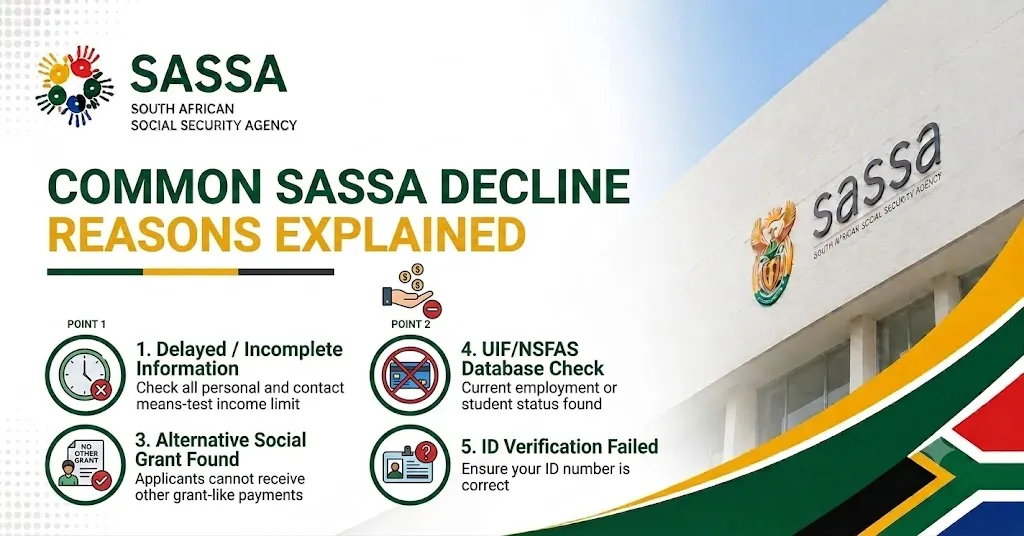
Common SASSA Decline Reasons Explained
Your status page will show a specific reason code. Understanding it is the first step to appealing correctly.
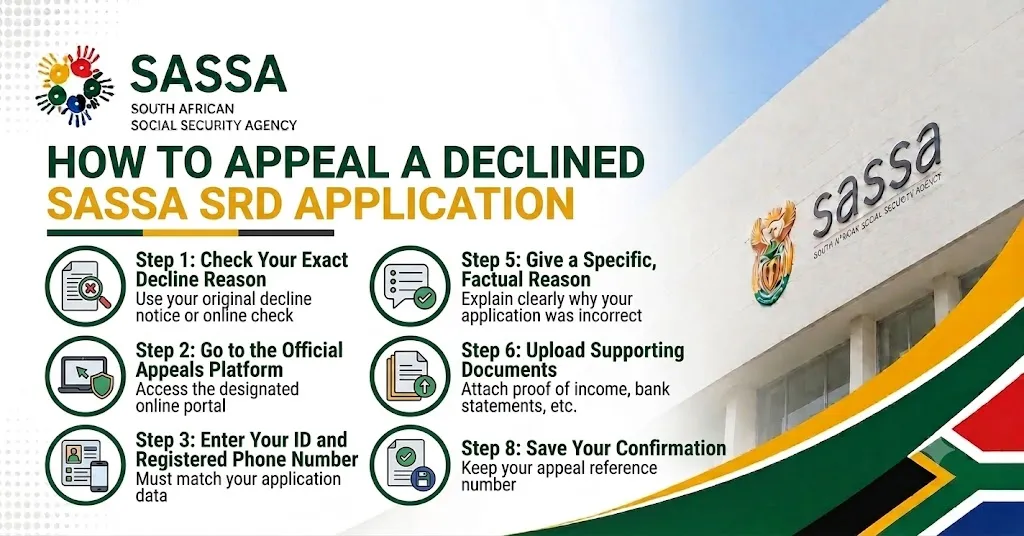
How to Appeal a Declined SASSA SRD Application
Step 1: Check Your Exact Decline Reason
Log in to srd.sassa.gov.za using your ID number and registered cellphone number. Your decline notice will show the specific reason code read this carefully before doing anything else, since it determines what your appeal needs to address.
Step 2: Go to the Official Appeals Platform
Visit srd.sassa.gov.za/appeals. This is the only official channel avoid any third-party site claiming to process appeals for a fee, since the SRD appeal is completely free.
Step 3: Enter Your ID and Registered Phone Number
These must match your original SRD application exactly.
Step 4: Select the Declined Month
Choose the specific month you’re appealing. If more than one month was declined, you’ll need a separate appeal for each though the portal does allow you to submit them all in one sitting.
Step 5: Give a Specific, Factual Reason
Match your explanation directly to the decline code shown. A vague appeal (“please help me, I need this grant”) is far harder for ITSAA to process than one that directly addresses the specific flag for example, confirming a UIF payment ended on a specific date.
Step 6: Upload Supporting Documents
Where relevant, attach proof: a UIF confirmation letter, an NSFAS cancellation letter, recent bank statements, or a corrected ID document. Label files clearly (for example, “Bank_Statement_Jan2026”) so reviewers can identify them easily.
Step 7: Submit Within 90 Days
You have 90 days from the date of your decline notice to submit an appeal. Don’t wait until the deadline approaches submit as soon as you’ve gathered your documents.
Step 8: Save Your Confirmation
Screenshot or save your submission confirmation and reference number. You’ll need this to track your appeal status going forward.
What Documents Strengthen Your Appeal
A little more detail (so it never fails): if your appeal reason references a document, make sure that document is actually uploaded before submitting a strong written explanation without the supporting proof is far weaker than one paired with clear evidence.
How Long Does a Declined Appeal Take to Process?
Once submitted, an appeal typically takes 60 to 90 days for ITSAA to review, since an independent panel is assessing the case rather than SASSA re-checking its own decision. If your appeal is approved, payment for that specific month is processed separately according to SASSA’s regular monthly payment cycle you won’t receive a lump sum for multiple approved months at once; each is queued and paid individually.
Tip: Track your appeal status through the same appeals platform you submitted it on. Status typically shows as Under Review, Approved, or Rejected once a decision is reached.
What Happens If Your Appeal Is Also Rejected?
If ITSAA upholds the original decline, that decision is final for that specific month there’s no further internal recourse. However, this only applies to that one month. You should still check and appeal any other declined months separately, and continue applying or being automatically re-assessed for future months, since a decline never carries over.
If you missed the 90-day window entirely, there’s still a limited chance ITSAA may accept a late appeal through a condonation process but this generally requires a strong, documented reason such as illness or hospitalisation, not simply not knowing about the deadline.
Comparison Table: Decline Reason vs. Appeal Fix
| Decline Reason | What It Usually Means | Strongest Appeal Evidence |
| Means/Income Source Identified | Deposit flagged as income | Bank statements showing actual income |
| UIF Registered | Flagged as active UIF recipient | UIF confirmation letter, last payment date |
| NSFAS Registered | Flagged as current NSFAS beneficiary | De-registration or completion letter |
| Existing SASSA Grant | Linked to another personal grant | Proof grant isn’t in your name |
| Identity Verification Failed | Home Affairs mismatch | Corrected ID document |
| Bank Details Incorrect | Payment can’t be processed | Updated, verified banking details |
So, matching your evidence directly to the decline code is the single biggest factor in a successful appeal — generic explanations without supporting documents are the most common reason appeals stall or fail.
Common Mistakes That Weaken a Declined Appeal
Tips for a Stronger Appeal

Thabo Nkosi (Founder, Social Security Advisor and Content Writer)
Thabo Nkosi is a social security advisor and writer specializing in South African SASSA grants and appeals procedures. He was born and raised in South Africa and has spent over a decade helping individuals and families navigate the South African social welfare system.
His experience as a social security advisor gave him in-depth knowledge of the SASSA grant system, the procedures before SASSA, the Department of Social Development, and everything related to the SASSA Appeal Tribunal and the Unique Beneficiary Reference Number.
FAQs
Final Thoughts
A declined SASSA status feels like a dead end, but for most applicants it isn’t one. The system that flags you is automated, checking millions of records against imperfect government databases and mistakes at that scale are common. The appeal process exists precisely for this reason, reviewed by an independent tribunal with no stake in the original call.
I really suggest reading your exact decline reason first, matching your appeal directly to it, and attaching the specific document that proves the flag was wrong that combination is what separates a fast, successful appeal from one that stalls.
And whatever you do, never pay anyone claiming they can guarantee your appeal’s approval; the process is free, and no one outside ITSAA can influence its outcome.