
SASSA Grants: Types, Amounts, Eligibility & How to Apply in 2026
If you’re trying to figure out which SASSA grant applies to you, how much it pays, or whether you actually qualify, this guide covers everything in one place.
South Africa runs eight main social grants through the South African Social Security Agency, and each one has its own age rules, income limits, and application process. Here’s exactly how they work in 2026.
Need Immediate Help?
Available Monday to Friday, 8:00 AM – 4:00 PM
Types of SASSA Grants
South Africa currently has eight main social grants, each targeting a different group:
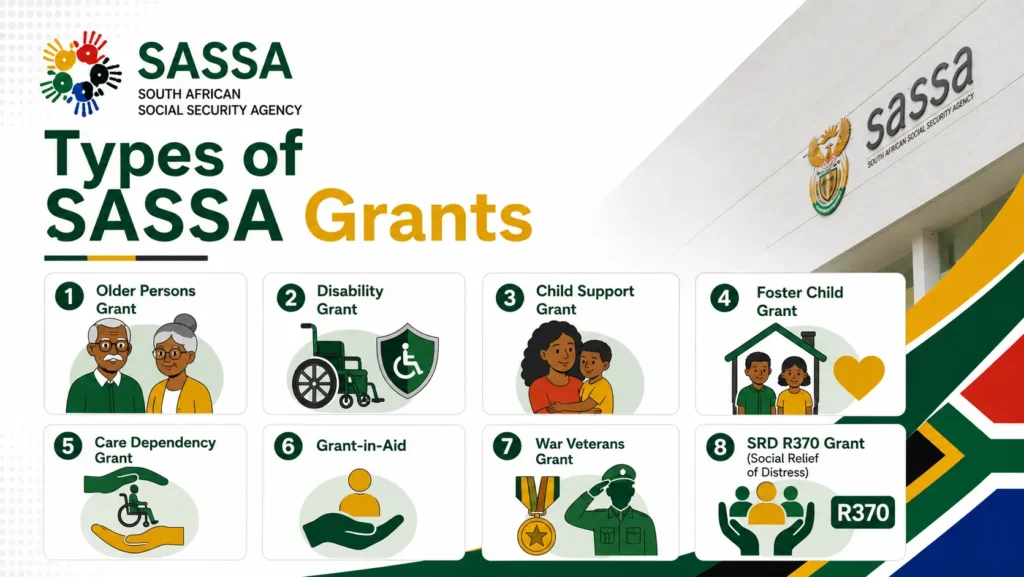
Older Persons Grant
R2,400 per month
Paid to South Africans aged 60 and older who pass the means test, this is the most widely claimed grant in the country and is often still referred to as the “old age pension.” It supports pensioners who no longer have a reliable income, covering essentials like food, electricity, rent, and basic healthcare.
The amount increases once you turn 75, and you don’t need to have contributed to a private pension fund to qualify the grant exists specifically for people who have limited or no other retirement income. Applications are free and must be done in person at a SASSA office, along with your ID and proof of income.
Disability Grant
R2,400 per month
Aimed at adults aged 18 to 59 who have a permanent or long-term disability that prevents them from working, this grant requires a medical assessment arranged through SASSA to confirm the disability meets the qualifying criteria. A doctor’s report and proof of income are both required as part of the application.
The grant is designed to cover daily living costs when illness or disability makes earning an income impossible, and it’s subject to the standard means test alongside the medical evaluation.
Child Support Grant
R580 per month per child
This is one of the most commonly claimed SASSA grants, paid to primary caregivers often parents or grandparents of children under 18 from lower-income households. It helps cover the everyday costs of raising a child, including food, clothing, and school-related expenses.
You can apply at any SASSA office, bringing the child’s birth certificate and proof of income for everyone in the household, since the caregiver’s income (not the child’s) is what’s assessed against the threshold.
Foster Child Grant
R1,290 per child per month
Paid to foster parents who have a child legally and formally placed in their care through a court order, this grant is not the same as the Child Support Grant and shouldn’t be confused with it. You must have an official foster care placement in place before applying, and you’ll need to bring the court order along with the child’s documents to your SASSA appointment.
Notably, this is the one grant where SASSA does not apply a means test to the foster parent eligibility rests on the legal placement itself, not the caregiver’s income.
Care Dependency Grant
R2,400 per child
This grant supports caregivers of children under 18 who need full-time, ongoing care because of a severe disability. It’s a distinct grant from Child Support, and applying requires medical evidence confirming that the child’s condition genuinely requires permanent, full-time care not just occasional assistance.
Applications are made at a SASSA office along with the child’s documents and the required medical report.
Grant-in-Aid
R580 per month
Rather than standing alone, Grant-in-Aid is a top-up paid on top of an existing Older Persons, Disability, or War Veterans grant, for beneficiaries who need someone else’s help with daily living cooking, bathing, or getting around.
It has to be applied for separately from your main grant, even if you’re already an approved beneficiary, and SASSA will assess your need for full-time care as part of that separate application.
War Veterans Grant
R2,420 per month
Reserved for surviving veterans of specific historical wars recognised under South African legislation, this grant pays a slightly higher amount than the standard Older Persons Grant in recognition of service history.
Qualifying criteria include age and verified veteran status, alongside the standard means test that applies to most adult grants.
SRD R370 Grant
SRD R370 Grant
Designed as temporary relief for unemployed South Africans aged 18 to 59 who have no other income or social grant, the SRD grant is the only one processed almost entirely online, through the official SASSA SRD portal rather than in person.
Because circumstances can change quickly for people in this situation, Eligibility is checked monthly rather than once at application so an approval one month doesn’t guarantee automatic approval the next if your income situation shifts. Funding for this grant has been confirmed through to 31 March 2027.
What Is SASSA and What Does It Do?
The South African Social Security Agency is the government body responsible for distributing social grants on behalf of the Department of Social Development. It reaches more than 27 million beneficiaries every month, making it one of the largest social assistance programmes on the continent. For a huge number of South African households, a SASSA grant isn’t a top-up it’s the primary source of income covering food, rent, transport, and school costs.
Every application, status check, reconsideration, and SASSA appeal through SASSA is completely free. If anyone asks you to pay a fee to “speed up” your grant, or asks for your banking PIN, that’s a scam SASSA will never ask for either.
SASSA Grant Amounts 2026
Following the 2026 Budget Speech, most permanent grants increased from 1 April 2026. Here’s what each grant pays per month right now:
| Grant Type | Monthly Amount (from April 2026) |
| Older Persons Grant (60–74) | R2,400 |
| Older Persons Grant (75+) | R2,420 |
| War Veterans Grant | R2,420 |
| Disability Grant | R2,400 |
| Care Dependency Grant | R2,400 |
| Foster Child Grant | R1,290 |
| Child Support Grant | R580 |
| Grant-in-Aid | R580 |
| SRD R370 Grant | R370 (unchanged) |
The old age and disability increases work out to roughly 3.7%, slightly ahead of current inflation, while the child support increase sits at around 3.6%. The SRD grant is the exception it holds steady at R370 and has been extended with an additional R36.4 billion in funding to keep running until 31 March 2027. If you already receive the Older Persons Grant and also qualify for Grant-in-Aid, your combined monthly total rises to R2,980 (or R3,000 if you’re over 75).
The SASSA Means Test Explained
Most SASSA grants, with the exception of the SRD R370 and the Foster Child Grant, use a means test to confirm you genuinely need financial support. In simple terms, SASSA checks your income and assets (and your spouse’s, if you’re married) against published thresholds for that specific grant. If your application is declined because of the means test, you may be able to submit a SASSA Appeal after reviewing the reason for the decision and gathering the required supporting documents.
A few things worth knowing:
If your income or assets sit above the relevant threshold, your application will be declined not because SASSA doubts your need, but because the system is designed to direct limited funds to those below the line.
How to Apply for a SASSA Grant
The application route depends on which grant you’re going for.
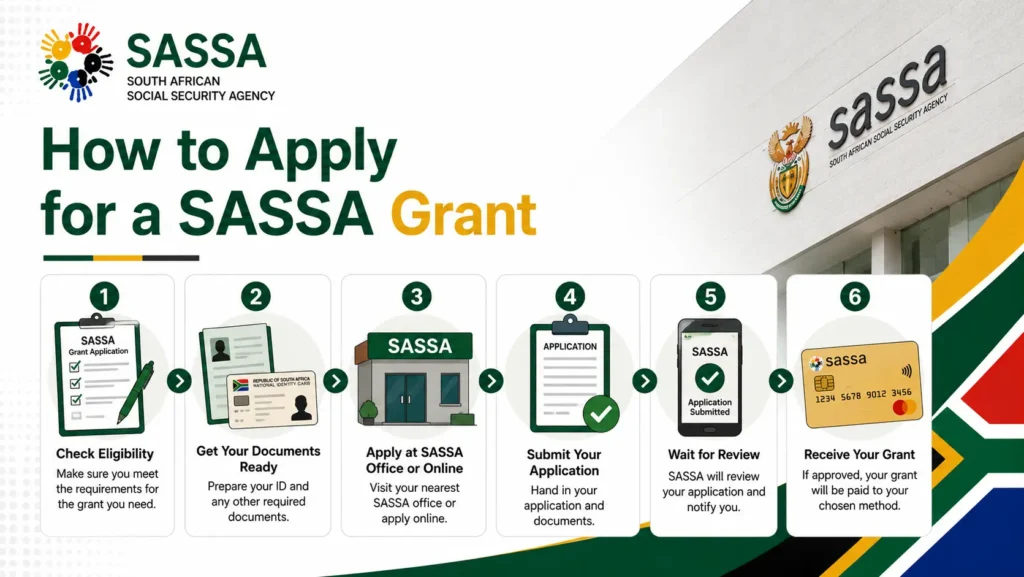
For permanent grants (Older Persons, Disability, Child Support, Foster Child, Care Dependency, Grant-in-Aid, War Veterans):
For the SRD R370 grant, the process is entirely digital:
Tip: Your SRD eligibility is re-checked every single month, so an approval this month doesn’t guarantee approval next month if your financial circumstances change.
Documents You’ll Need
Requirements vary slightly by grant, but generally you should have on hand:
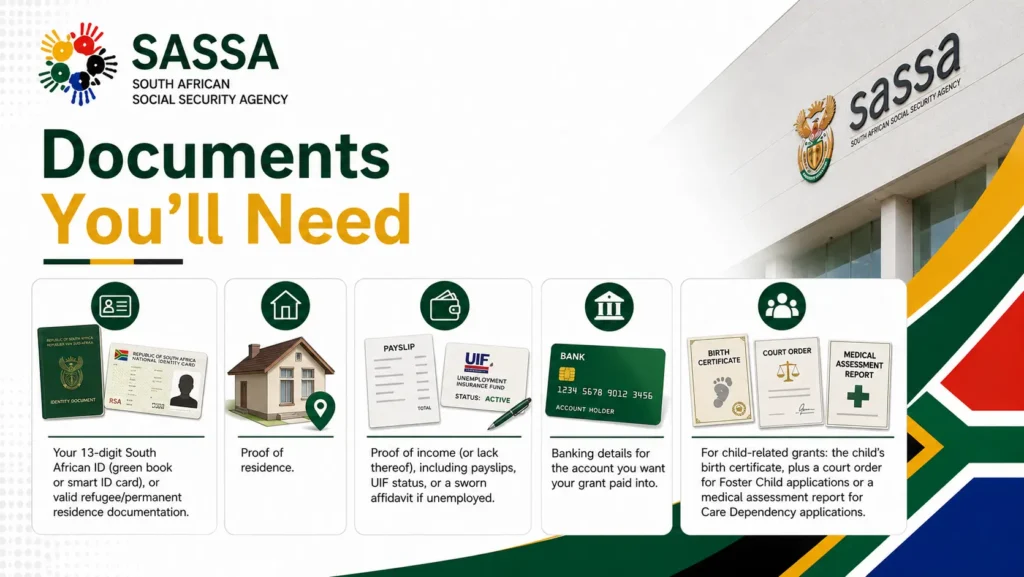
Any document copies must be certified by SAPS or a Commissioner of Oaths, and that certification stamp needs to be dated within the last three months. Arriving with outdated certification is one of the most common and most avoidable reasons for delays at a SASSA branch, which can also affect when you receive your grant. To stay informed, check the latest Payment Dates before planning your visit or expecting your next payment.
SASSA Payment Methods
Once approved, you can receive your grant through:
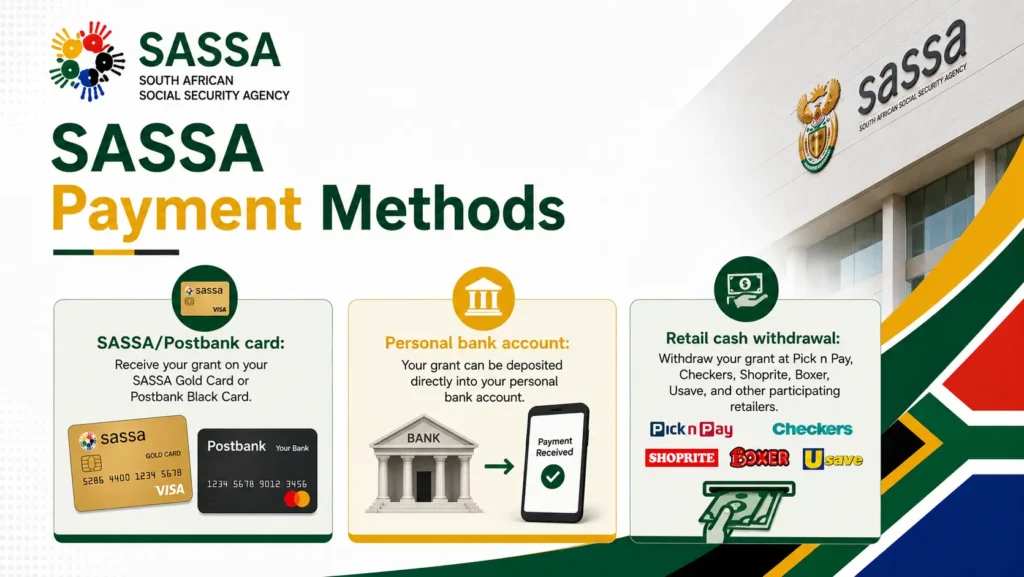
Your money stays available on your card or in your account indefinitely — there’s no deadline to collect it, and no penalty for withdrawing a few days after your official payment date.
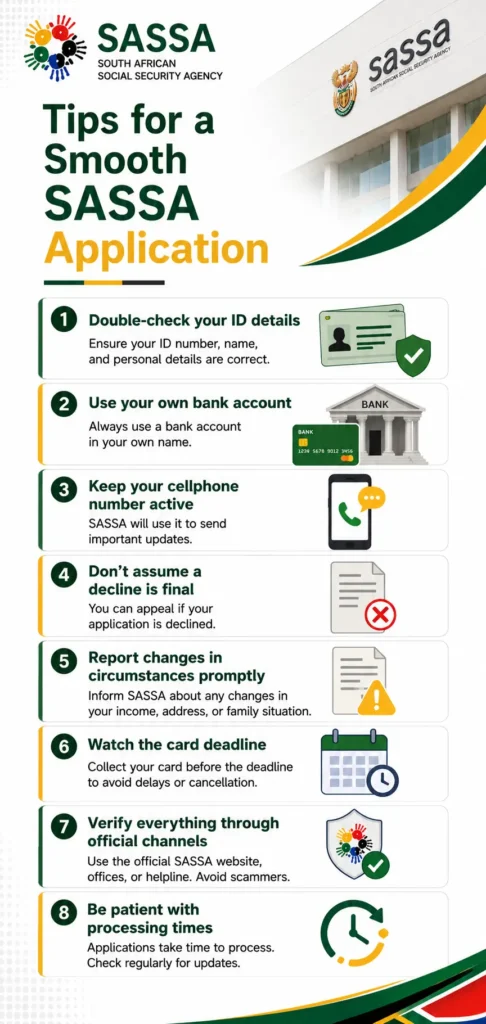
Tips for a Smooth SASSA Application
Double-check your ID details
Your name, surname, and ID number must match Home Affairs records exactly even one incorrect character can hold up an application for weeks.
Use your own bank account
Applications using someone else’s account, even a family member’s, are a common cause of payment failures and delays.
Keep your cellphone number active
SASSA sends verification links and payment notifications by SMS — if your number changes, update it immediately.
Don’t assume a decline is final
Reconsiderations and appeals are free and often successful when the original decision was based on an income error.
Report changes in circumstances promptly
A new job, a change in household income, or a change of address should all be reported to SASSA — not reporting changes can lead to a suspension later.
Watch the card deadline
If you’re still using an old SASSA Gold Card, swap it for the Postbank Black Card well before 31 August 2026 rather than waiting for the last week
Verify everything through official channels
Use sassa.gov.za or the toll-free helpline, not third-party Facebook pages or WhatsApp groups claiming to speed up applications.
Be patient with processing times
Permanent grants can take up to three months to process, but your payment will be backdated to your original application date.

Thabo Nkosi (Founder, Social Security Advisor and Content Writer)
Thabo Nkosi is a social security advisor and writer specializing in South African SASSA grants and appeals procedures. He was born and raised in South Africa and has spent over a decade helping individuals and families navigate the South African social welfare system.
His experience as a social security advisor gave him in-depth knowledge of the SASSA grant system, the procedures before SASSA, the Department of Social Development, and everything related to the SASSA Appeal Tribunal and the Unique Beneficiary Reference Number.
FAQs
Final thought
The SASSA system is built around means-tested support for people who genuinely need it, so the fastest route to approval is accurate documentation and honest reporting of your income and assets from the start. Keep your details current, use official channels only, and you’ll avoid the vast majority of delays other applicants run into.