
SASSA Grant Eligibility: SRD R370, Pension & All Grant Criteria
Before you fill in a single form, it’s worth knowing exactly where you stand. SASSA Grant eligibility isn’t one set of rules — it’s a different combination of age, income, assets, and circumstances for each of the eight grants.
Need Immediate Help?
Available Monday to Friday, 8:00 AM – 4:00 PM
General SASSA Grant Eligibility Rules
Whichever grant you’re applying for, a handful of baseline rules apply across the board. You must be a South African citizen, a permanent resident, or a recognised refugee living in South Africa. Your income and your spouse’s, if you’re married must fall below the threshold set for that specific grant. Your assets must also stay under the relevant limit, though your primary home and basic household goods are excluded from that calculation.

You can only receive one main grant for yourself at a time. The single exception is Grant-in-Aid, which is paid as a top-up alongside an Older Persons, Disability, or War Veterans grant when you need full-time care. And critically, applying for any SASSA grant, along with lodging a reconsideration or appeal, is always free. If someone asks you to pay a fee to speed up an application or share your banking PIN, that’s a scam, not a shortcut. If your application or reconsideration is unfairly rejected, you can submit a SASSA Appeal Online through the official process without paying any fees.
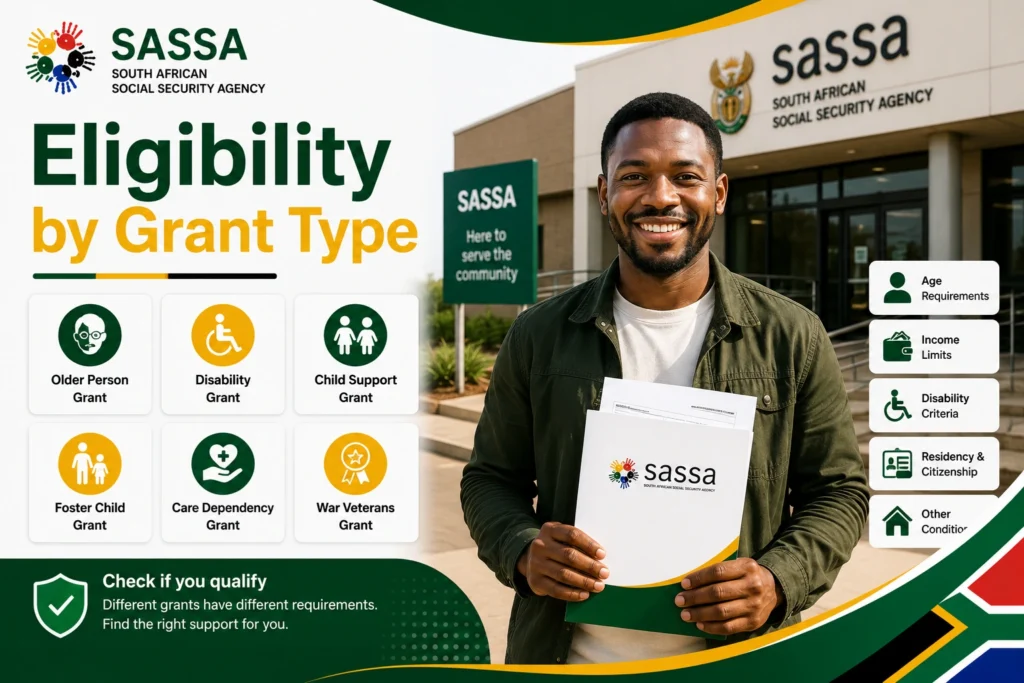
SASSA Grant Eligibility Rules by Grant Type
Each grant has its own specific qualifying conditions layered on top of the general rules above.
You need to be 60 years or older, a South African citizen, permanent resident, or recognised refugee with a valid Section 24 permit, and pass the means test based on your income and assets (and your spouse’s, if married). You don’t need to have contributed to a private pension fund this grant exists precisely for people without that kind of retirement income. If you’re absent from South Africa for more than 90 consecutive days, your payments may be suspended, so it’s worth notifying SASSA in advance of any extended trip abroad.
SASSA SRD Eligibility runs from age 18 to 59, and you’ll need a medical assessment confirming a permanent or long-term disability that stops you from earning a living. A doctor’s report is required alongside proof of income, and the standard means test applies. Working while receiving this grant is allowed there’s no blanket rule against earning some income but your total earnings need to stay within the threshold, and the payment adjusts on a sliding scale based on what you declare.
Available to primary caregivers parents, grandparents, or other guardians of children under 18, provided the caregiver’s household income falls below the threshold. It’s the child’s living situation and the caregiver’s income that matter here, not the child’s own finances. You’ll need the child’s birth certificate and proof of income for everyone in the household when you apply.
This is the one grant where the caregiver isn’t means-tested. Instead, eligibility hinges entirely on having an official court order placing the child in your care as a foster parent. Without that court order, you can’t qualify no amount of financial need substitutes for the legal placement.
For caregivers of children under 18 who need full-time, ongoing care due to a severe disability. Medical evidence is essential here a report confirming that the child’s condition genuinely requires permanent full-time care, not occasional assistance, is what separates this grant from Child Support.
You already need to be receiving an Older Persons, Disability, or War Veterans grant to qualify for this top-up, and you’ll need to demonstrate that you require a caregiver for daily activities like cooking, bathing, or moving around. It’s applied for separately from your main grant, even though you’re already an approved beneficiary of another one.
Reserved for surviving veterans of specific historical wars recognised under South African legislation. Alongside verified veteran status, the standard means test and residency requirements still apply.
Open to South Africans aged 18 to 59 who are unemployed and receive no other income or social grant. Unlike the other seven grants, this one uses a much simpler monthly income check rather than the full means test, and eligibility is re-verified every single month rather than once at application. An approval this month is genuinely no guarantee for next month if your financial circumstances change.
SASSA SRDCitizenship and Residency Requirements
To qualify for any SASSA grant, you need one of the following statuses: South African citizenship, permanent residency, or recognised refugee status with a valid Section 24 refugee permit. Asylum seekers holding only a Section 22 permit do not qualify this is a common point of confusion, since Section 22 and Section 24 permits are easy to mix up but carry very different grant eligibility outcomes.
SASSA verifies citizenship and residency status directly against the Home Affairs database as part of processing your application, so there’s little room for error here your details need to match exactly what’s on record. Refugees who are approved for a grant will have that grant reviewed when their refugee status is due to expire, so it’s worth keeping your documentation current well ahead of any renewal date. Once your application is approved, you can check the latest Payment Dates to see when your grant is scheduled to be paid.
Common Reasons Applications Are Declined
Understanding why applications get turned down can help you avoid the same pitfalls:
If you’re declined, you have the right to a free reconsideration or appeal, and SASSA is required to give you the reason for the decision so you know exactly what to address.
How to Check If You Qualify Before Applying
Rather than guessing, there are a few ways to get a clearer picture before you make the trip to a SASSA office:
What Happens After You’re Approved
Being approved isn’t necessarily the end of the story. SASSA can review your grant at any point to confirm you still qualify, and you’ll receive written notice at least three months ahead of any scheduled review. If your grant is paid through a bank, institution, or procurator, you’ll also need to submit a life certificate at a SASSA office once a year to confirm you’re still alive and still eligible.
Reviews have become noticeably more frequent in 2026 as part of SASSA’s broader compliance drive, so keeping your paperwork and personal details current matters more than it used to. Any change in your circumstances a new job, a change in household income, or a change of address should be reported to SASSA promptly, since failing to report changes can lead to a suspension further down the line.

Thabo Nkosi (Founder, Social Security Advisor and Content Writer)
Thabo Nkosi is a social security advisor and writer specializing in South African SASSA grants and appeals procedures. He was born and raised in South Africa and has spent over a decade helping individuals and families navigate the South African social welfare system.
His experience as a social security advisor gave him in-depth knowledge of the SASSA grant system, the procedures before SASSA, the Department of Social Development, and everything related to the SASSA Appeal Tribunal and the Unique Beneficiary Reference Number.